

A data center that trains frontier models is national security infrastructure. A factory that produces humanoid robots is national security infrastructure. A chip fab, a uranium enrichment facility, a rocket launch facility, a rare earth processing line. All of it. The buildout now underway is not happening alongside national security policy. It is becoming national security policy.
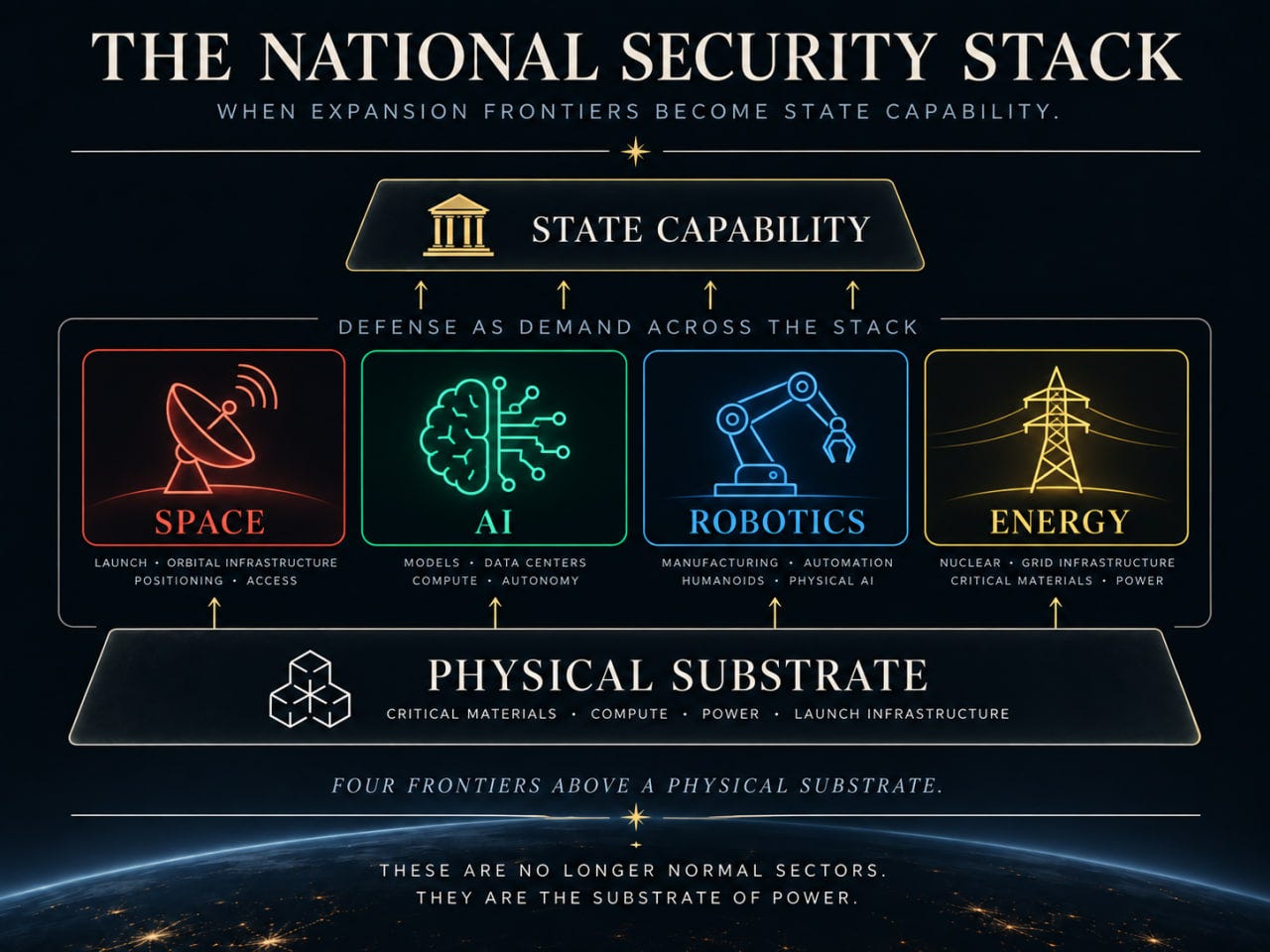
This is the National Security Stack. It is the integrated set of frontier industries that nation-states now treat as strategic assets rather than commercial sectors. The four frontiers of this buildout (AI, robotics, energy, space) are not separate sectors that happen to be growing. They are pieces of a single national capability stack, and serious states are organizing themselves to control as much of that stack as they can.
You may notice defense is not on the list because it is not a frontier; it is the envelope. It is what the other four become under pressure, the state’s demand function running across all of them. A drone maker is robotics with a government customer. A launch provider is space with a clearance. There is no defense sector in this framework. There is the stack, and the share of it the state claims.
Biology is not on the list either. It is coming. For now, bio enters the stack through the AI layer: every frontier lab already treats biological capability as a weapons question, and the policy apparatus is beginning to agree. But the four frontiers above are defined by physical buildout the state can fund, fence, and defend. When governments start buying biological capability the way they buy launch, the stack gets a fifth pillar.
What It Looks Like
Data centers are going to be hardened, defended, and in some cases physically protected by uniformed personnel. The new clusters are critical infrastructure under multiple legal frameworks, and the operational security requirements will reflect that.
Robot factories are going to be subject to export controls, security clearances, and protected status under critical infrastructure law. The companies producing humanoid platforms at scale will find themselves negotiating with defense ministries the way semiconductor companies negotiate today.
AI models above a certain capability threshold are already treated like weapons systems for purposes of export, deployment, and ownership. Washington decides which chips cross which borders, and in 2025 it began taking a cut: the two leading AI chipmakers agreed to hand the US government 15% of their China chip revenue in exchange for export licenses. A state toll on the outbound flow of strategic capability.
Energy infrastructure that supports the buildout (nuclear plants, enrichment, transmission, critical commodity supply) is being subsidized, fast-tracked, and strategically directed. Several G7 governments are implementing forms of intervention in their domestic energy stacks that would have been unthinkable a decade ago.
Space infrastructure is already partly classified. It is becoming more so. Launch capacity, orbital sensing, satellite communications, and lunar logistics will operate inside frameworks that look more like the defense industrial base than the commercial telecom industry.
Critical materials are the stack’s most concentrated national-security exposure. Copper, lithium, rare earths, tungsten, antimony, gallium, germanium. China largely controls the processing for all of them, and Beijing has stopped pretending otherwise: an outright ban on gallium, germanium, and antimony exports to the US in late 2024, then rare earth and magnet controls in April 2025 that froze Western auto lines within weeks, then another tightening in October. These metals are in the missile, the radar, the magnet, the night-vision optic, the engine. An entire generation of Western defense systems runs on a supply chain the West does not control. The reshoring is happening, expensively and with heavy subsidy. The companies building the alternative supply chain are not just being supported. They are being underwritten.
Who Sets the Price
The companies building the stack are going to have government in the room: intelligence liaisons, export rules, security obligations, national-interest constraints that 2010s tech companies would have considered insane. The ones that resist will lose contracts and access. The ones that embrace the integration will gain protection, capital, and structural advantage that nobody outside the security frame can compete with. But state protection is not free. The same designation that brings subsidy, contracts, and capital access also brings price controls, forced domestic sourcing, export restrictions, political oversight, and eventually nationalization risk. Strategic asset status is a moat and a leash.
So which one dominates? The defense primes have held strategic status for seventy years, and it bought them cost-plus contracts, single-digit margins, and returns that came from buybacks rather than growth. If “the government will defend it” were sufficient, Lockheed would have been the trade of the century. It was not. Protected and owned is not a growth story... it’s a coupon.
The variable that separates the winners from the hostages is who owns the demand curve.
If the government is your only customer, the leash dominates. You get the moat, and with it a margin cap, procurement politics, and an upside that belongs to the taxpayer. You become infrastructure with a share price.
If the government protects you while commercial markets set your prices, the moat dominates. TSMC is subsidized, defended, and treated by two superpowers as the most important physical asset on earth, and its prices are set by commercial customers bidding for scarce leading-edge capacity. SpaceX is anchored by national security launch and priced by a commercial market it dominates. That is the position: the state guards the gate, the market sets the toll.
The best structure in the stack is the hybrid the MP Materials deal. A government floor under the downside, commercial demand stacked on top. The state de-risks the capex. The market prices the output. Heads you compound. Tails the Pentagon owns your risk.
The equity itself is the tell. Washington is no longer just subsidizing the stack, It is buying it. The Pentagon on MP’s cap table. Stakes in the lithium and Alaskan copper developers. A golden share written into the US Steel acquisition. The state is assembling a portfolio of the assets it intends to keep, and a state does not let its own book fail. A government stake is the designation made explicit: that company will be defended, subsidized, and utilized, because the taxpayer is now long. The holdings are a published watchlist. But a stake does not change who owns the demand curve. It changes who absorbs the downside.
Intel is the live test of the framework. The state took 10% of a company the market had written off, and the stake alone settles nothing: a backstop under a melting business is still a melting business. Watch what stacked on top. SoftBank put in two billion. Nvidia followed with five billion and a chip partnership within weeks of Washington moving. The deal terms are even built to keep the foundry majority American-owned. What is still missing is the MP move: steered demand. The day Washington starts directing volume to the last American-owned leading-edge fab, this becomes the hybrid at semiconductor scale. That is the long-term bull case, and note what it bets on: the state finishing what it started.
When you look at any company inside the envelope, ask one question: who sets the price? If the answer is a procurement office, you are buying a bond with political risk attached. If the answer is a market, while the state guards the moat, you are looking at the most defensible equity on earth.
The End of the Biological Soldier
One piece deserves its own name.
The era in which the biological soldier is the default unit of deployment is ending. Not all at once, not cleanly, and not everywhere. But the procurement curve is moving away from humans as the first deployed unit and toward drones, autonomous systems, sensors, and robotic persistence. Ukraine settled the argument: small drones now account for the majority of battlefield casualties, and both sides build them by the million per year. Western procurement is reorganizing around that fact. The same humanoid and drone platforms being scaled for warehouses and factories are being scaled, in different versions, for these operations.
Alongside that shift, governments are going to converge on mass surveillance as the operating model in zones where they want to control resources or contain unrest. Drones overhead. Sensors on the ground. Persistent monitoring of populations and movements, executed by systems that do not need to sleep, eat, or be rotated home. This will be presented as security. It will also be the largest expansion of state observation capacity in human history, and it will land first in the places governments care about most: where the minerals are, where the supply lines run, and where the people are restive.
I am not endorsing this. I am telling you it is happening, and that the companies building these capabilities will be among the most valuable strategic assets of the coming decade. Every previous expansion of the military-industrial base has produced both real productive spillover and real destructive consequences. This one will too.
But here is the part most analyses skip: the democracies are starting to draw lines through this market, and the lines are investable. This month, the CEO of one of the leading AI labs published a policy framework calling for fully autonomous weapons to be banned from domestic law enforcement, hardwired to refuse unlawful orders, and for the data-broker loophole that feeds bulk surveillance to be closed. Proposals like that are moving from think pieces toward statute. If they land, the market bifurcates by jurisdiction: domestic deployment constrained by constitutional guardrails, allied and export demand far less so. The companies that can build persistent autonomy for the coalition’s edge while staying inside the guardrails at home will capture both sides of the split.
Do not make the mistake of reading the guardrails as a tax on the thesis. They are what makes the Western stack durable. A security architecture that requires repressing its own population is brittle; it manufactures its own backlash. Legitimacy is a strategic asset too, and it is the one asset the other bloc cannot copy.
How the Market Misprices It
The entire stack of frontier technology now operates inside a national security envelope, and the envelope tightens every year. Pricing companies inside this envelope as if they were ordinary consumer or enterprise software businesses is mispricing them. They are dual-use strategic assets in a fragmenting world, with all the upside and all the constraints that designation carries.
This is partly why the largest frontier companies have attracted capital at valuations that look insane to traditional analysts. The analysts are pricing commercial businesses; these are no longer commercial businesses. They are pieces of state capability with a commercial revenue line attached. Sometimes that makes the valuation more rational than it looks: a state backstop under the downside is worth turns of multiple that no spreadsheet captures. And sometimes the same designation is the warning: where the state owns the demand curve, you are holding the coupon, not the compounder.
You either build inside the National Security Stack, or you build around it. There is no neutral position anymore.
Alpha: the strategically protected category is the durable category, but only part of it compounds. Buy what governments will defend, subsidize, and onshore.