

Start with the axiom that almost nobody operates by but almost everyone is governed by: for the purposes of mass behavior, perception is reality. Not metaphorically, but operationally. This is an ontological claim, not a poetic one: what a population treats as real is real, in every way that produces consequences. The world humans act in is the world humans perceive. If a million people see something rendered convincingly, they act on it as real, and their actions become real consequences in the actual world. Change what people perceive and you change what people do. Change what people do at scale and you change the world. The shortest path to changing reality at scale is changing perception at scale. Memes are the vehicle of that change. That is the dynamic this chapter is about.
For all of human history, our sense of what is real has been bounded by what we can directly see. We perceived the world at human scale. We trusted that systems existed above us and below us, but we did not see them. We read about them in textbooks. We trusted the experts who could see them.
Every once in a while, a new visualization technology arrived and the boundary of reality jumped. The telescope opened the heavens. The microscope opened the body. The X-ray opened the skeleton. The satellite opened the planet. Each one made invisible systems visible to ordinary humans for the first time. After Galileo, the heavens were a different place. After van Leeuwenhoek, the body was a different place. After the Apollo photograph of Earth, the planet itself looked different to anyone who had ever looked up at it.
We are inside another one of those jumps. This one may be broader than any before it, because it does not reveal a single hidden domain. It can render almost any hidden system. Almost nobody is treating it that way.
AI is beginning to render complex systems as direct visual experience. Not diagrams. Not metaphors. Living, photorealistic, navigable images of things that were previously only equations in a researcher’s notebook.
The interior of a human cell, with every protein in motion, in detail close enough that a non-biologist can grasp the architecture in seconds. Migration flows across a continent, rendered as moving dots that anyone can interpret in a glance. Market microstructure during a flash crash, played back as a navigable simulation. Climate dynamics, disease propagation, neural activity, supply chain choke points. Political coalitions, voting blocs, and the structure of power itself, rendered visible in ways that change how citizens reason about who actually decides.
None of this is new information. Many of these systems were understood, mathematically or structurally, by specialists, for years or decades. What is new is that the systems are now visible to ordinary humans, in compressed forms that travel at the speed of the feed.
The Wall Falls
For most of history, the cognitive distance between expert and layperson was a wall. Specialists did the math. Specialists wrote the papers. The findings, eventually, would be translated into popular books and journalism, with most of the structure lost in translation. The general public never had access to the actual model the specialist held in mind. Politics, policy, and public discourse were therefore conducted at the level of slogans, never systems.
There was also a second wall. Corporations and editors decided what got published, when, and to whom. Information moved through institutional filters before it reached the public. Stories were vetted, approved, killed, or buried by people whose names ordinary readers never learned.
Both walls are collapsing. AI visualization is collapsing the first. The weakening of the old gatekeepers is collapsing the second. Anybody with an internet connection can now put out information that spreads at the speed of the feed and changes perceptions of reality instantaneously.
A two-minute visualization of donor networks and money flows gets generated by a model, posted on a feed, and watched by ten million people in a week. Those ten million now hold a structural model of how power operates that was previously available only to insiders, lobbyists, and investigative journalists. They can see who funds whom, when, and through what mechanisms. They are not experts. But they have a picture in their heads that they did not have before, and the picture travels with them.
This applies to every domain that was previously locked behind specialist understanding: power structures, political coalitions, donor networks, oil and gas flows, lobbying networks, macroeconomics, demographics. Each one is about to become memetically accessible.
The Memetic Century
Call this the Memetic Century: the dynamic in which the modern information environment selects for memetic fitness over accuracy. Visualization is the ultimate memetic vehicle. A compelling image bypasses verbal argument entirely. It enters the brain through a different door than language, lodges in memory more durably, and propagates more virally. When AI generates the image, the production cost approaches zero, and the volume goes vertical.
Richard Dawkins coined the word “meme” in 1976 to describe self-replicating units of culture, long before the internet turned the word into a punchline. A meme is a unit of culture that jumps from brain to brain, mutating, competing, and reproducing on the same selection logic that governs every other replicator. Memes get selected not for being true, not for being good for the host, but for being good at copying themselves.
A meme is not an argument. It is a feeling wearing the costume of an argument. The feeling is the payload. Everything else is decoration. You cannot moderate your way out of a selection pressure.
The compression of complexity into shareable image is one of the most underrated forces of the coming decade. Whoever can compress a complex system into a viral visualization effectively defines what the public believes that system is.
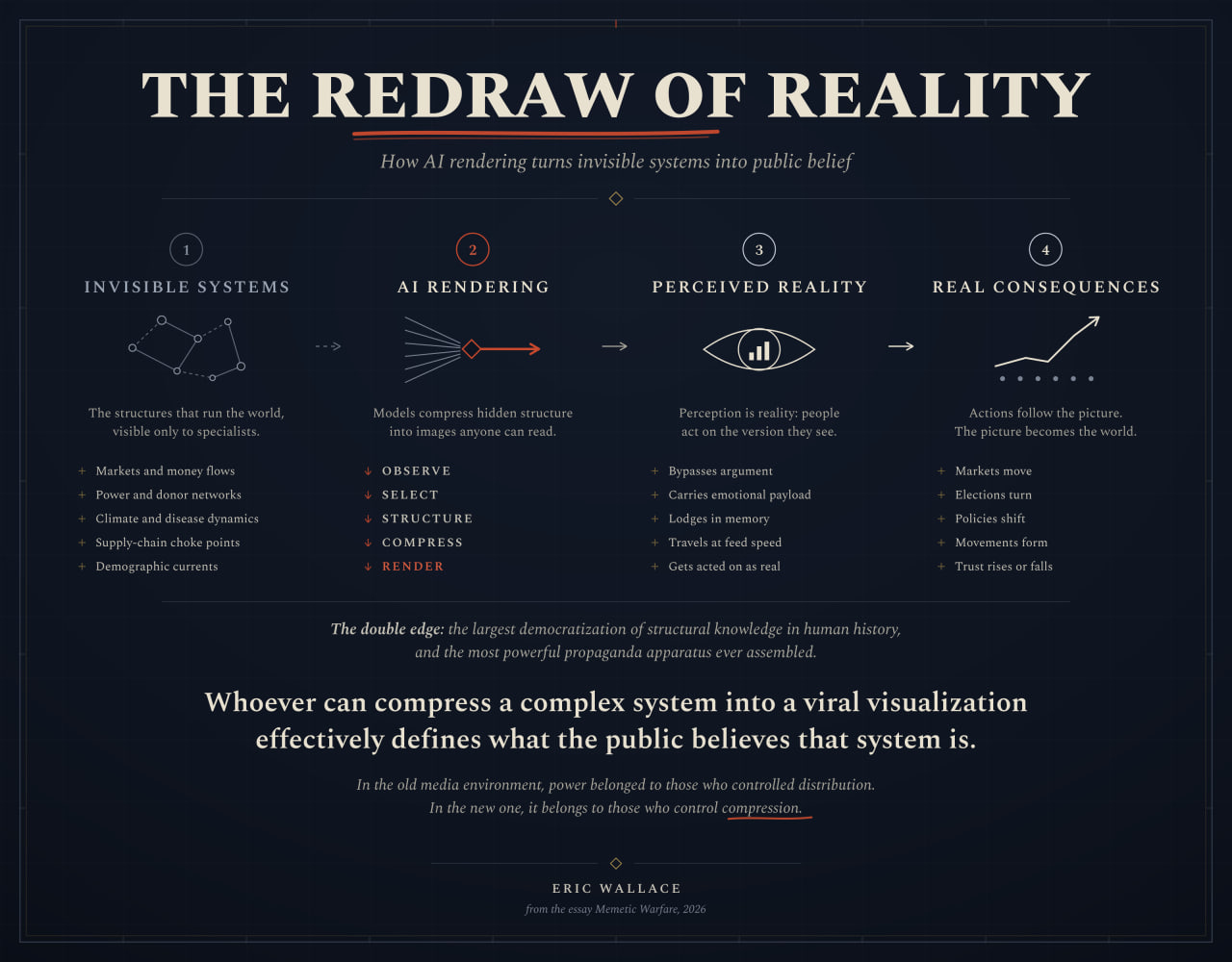
Visualization plus memetics is the new shape of public power. The image and the meme together do what speeches and op-eds used to do, faster, cheaper, and more emotionally direct. The most influential political communicators are increasingly not the ones with the best speeches or the best policies. They are the ones with the most compelling renderings of complex systems, and the ones whose slogans carry the superior memetic fitness. The ones who can compress, not lecture. In the old media environment, power belonged to those who controlled distribution. In the new one, it belongs to those who control compression.
I have watched this dynamic play out in real time. As a co-founder of Pepe, one of the most successful memetic assets in crypto, I watched a compressed image move at the speed of the feed and outrun every framework built to price it. Citing that in a paper arguing for substrate over narrative looks like a contradiction, but it is the whole point. I saw, from the inside, how completely narrative can detach from production and still command a price. That is exactly how I learned to value the thing underneath. That detachment does not make the price fake. It makes it powerful, unstable, and dangerous to misunderstand. When the music stops, you want to own the thing the memes point to, not only the meme itself. I am writing about substrate now because I have seen what the alternative is made of.
There is a second reason to watch memes, and it has nothing to do with trading them. A meme is a signal. It is where a shift in what people believe becomes visible before it shows up in prices, in politics, or in institutions. By the time a change is legible in the official numbers, it has usually been alive in the memes for a while. The same way capital follows talent on a lag, the slow systems follow the memes on a lag. Reading them is not frivolous. It is one of the earliest available reads on what is about to move.
The financial consequences are the early signal. The political ones are coming. The dynamic does not stop at markets and politics. Science communication, cultural memory, military narrative, geopolitical perception, supply chains, public health, and the framing of any large complex system are all subject to the same selection pressure. The same compression that turns an image into a multi-billion-dollar digital asset can turn an image into a movement, a policy outcome, or an election result. The mechanics that built the last decade of memetic assets will increasingly build political reality. Whoever masters them wields a form of power that legacy institutions are not equipped to counter and have not yet taken seriously.
The Double Edge
What I have been describing has a double edge, and it is sharp on both sides.
On the bright side, we are inside the largest democratization of structural knowledge in human history. The complexity of the world, which has been opaque to most people for the entirety of civilization, is becoming legible. Public understanding of disease, environment, economics, and infrastructure is going to deepen at speeds that have no precedent. Decisions made in ignorance for centuries are going to be made with more grounded mental models. This is profoundly good.
On the dark side, the same tools enable the most powerful propaganda apparatus ever assembled. A visualization does not need to be true to be persuasive. It only needs to be compelling. AI can produce compelling visualizations of false claims as easily as true ones. Political actors, foreign and domestic, are flooding the discourse with weaponized renderings of demographic flows, economic outcomes, cultural changes, and historical events that may bear no relation to actual data. The visualizations will travel faster than corrections. The corrections will be less compelling than the originals.
The cumulative effect is a media environment in which what people “see” diverges from what is actually happening, in directions chosen by whoever owns the rendering capacity.
This dynamic feeds the Coalition of Fear directly. People who already feel afraid are being shown more compelling, more immersive, more emotionally devastating versions of what they fear. The fear is being cultivated by actors who understand exactly what they are doing. Some of those actors are foreign. Some are domestic. Some are not actors at all but algorithms optimizing for engagement without regard to consequence.
We are going to spend the next decade trying to figure out how to live with this. The current generation of platforms, regulators, and journalists is not equipped for it. The volume and quality of synthetic visualization is climbing a curve that legacy verification cannot match.
Notice the Redraw
The reality you are operating in is being rewritten in real time by the rendering capacity of intelligent systems. Some of what you “know” about the world in five years, you will know because you saw it in an AI-generated visualization that compressed something previously invisible into something memorable. Some of it will be true. Some will not. The discipline of distinguishing the two is going to become one of the most important cognitive skills of the coming decade. The response is not to reject visualization. It is to demand the kind that is source-linked, auditable, and grounded in real data, and to distrust the kind that is not.
There is a layer beneath opinion and narrative. Call it the ontological layer: the set of things a person takes to exist and to be true. For all of history it was shaped by what we could directly perceive. Now it is shaped by what gets rendered. That is the deepest level of what is being redrawn, and it is why this matters more than the word “misinformation” can carry. Misinformation is a wrong fact inside a shared reality. This is the editing of the reality itself.
The map of reality is being redrawn. Most people will live inside the new map without noticing the redraw happened. The ones who notice will be in a position to act on the rendering rather than be acted on by it.
The redraw is already underway.
Notice it.